


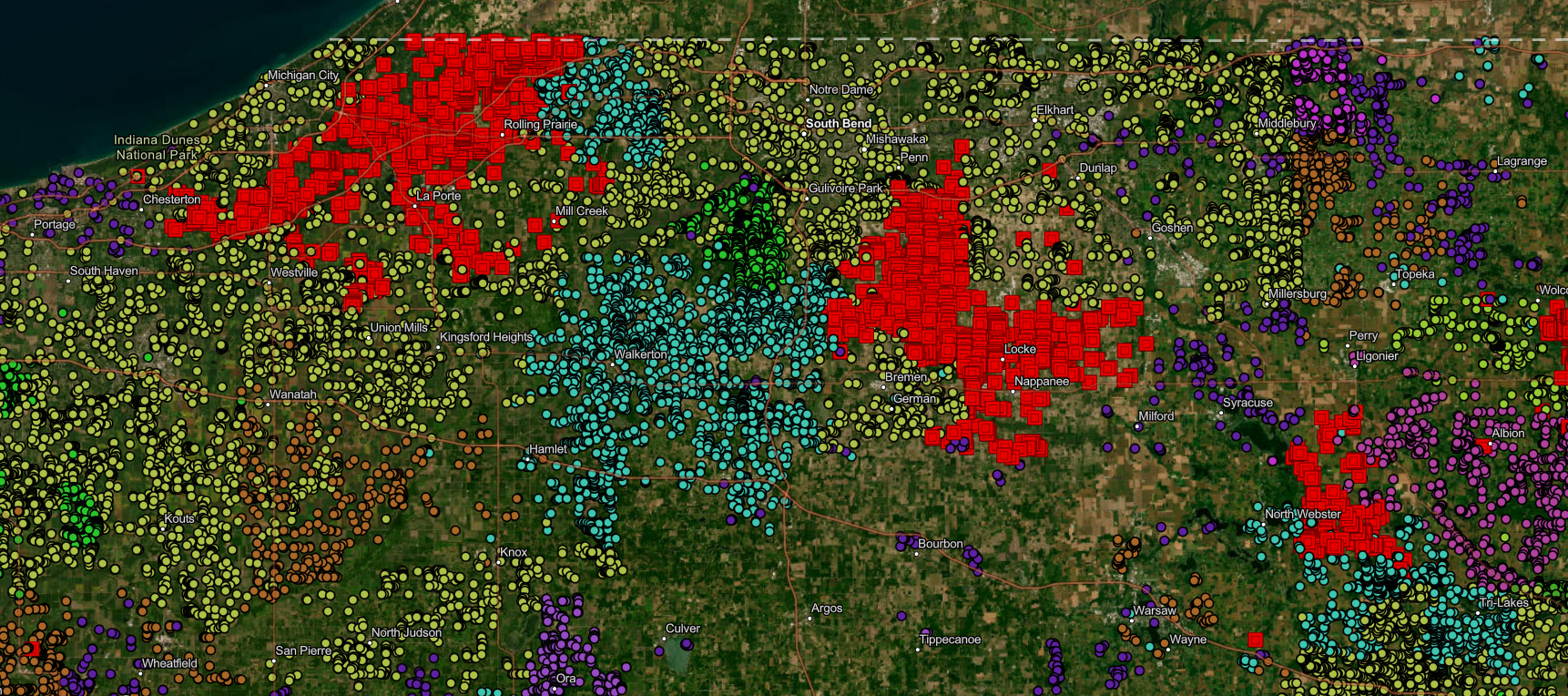
The Broadband Equity, Access, and Deployment (BEAD) program represents one of the most significant infrastructure investments in modern American history, with $42 billion allocated nationally to close the digital divide. Indiana’s share, approximately $868 million, is both transformative and, in many ways, insufficient for the long-term demands of a digitally dependent economy.
Indiana BEAD Locations
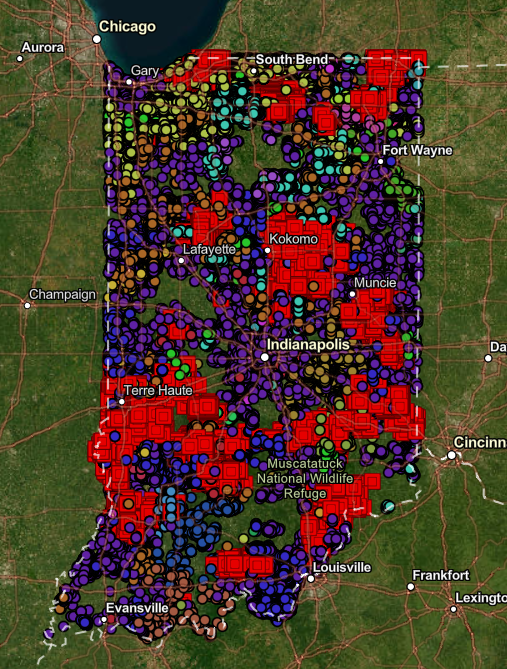 While at first glance it appears to be a simple coverage map, deeper analysis reveals a layered narrative about infrastructure gaps, demographic patterns, economic geography, and the future of connectivity across the state.
The ArcGIS BEAD map builds on datasets such as the FCC Broadband Map and Indiana’s own Connecting Indiana platform, identifying each broadband serviceable location and classifying it as served, underserved, or unserved. At its core, the map reflects three critical realities. It shows the geography of inequity, where large portions of rural Indiana, particularly in southern, west central, and parts of northeast Indiana, remain unserved or underserved. It reveals the fragmentation of infrastructure, where even in relatively developed counties broadband availability is inconsistent and often stops at the edge of towns or along major roadways. It also illustrates the prioritization logic of BEAD, where funding flows first to unserved areas, then underserved areas, and finally to community anchor institutions. Taken together, this is less a static picture and more a blueprint for where Indiana must invest to achieve digital parity.
When examined regionally, the map highlights clear spatial patterns that align closely with the state’s economic and geographic structure. In agricultural corridors stretching across counties such as Greene, Daviess, and parts of LaGrange and Noble, there are some of the highest concentrations of unserved locations. These areas face a dual challenge. Low population density increases the cost per connection, and long distances between nodes require extensive middle mile infrastructure. This explains why BEAD projects in these regions tend to be bundled into larger geographic packages rather than isolated builds.
At the same time, the map reveals a less obvious but equally important issue in peri urban areas. On the edges of growing cities such as Indianapolis, Fort Wayne, and South Bend, there are notable pockets of underserved locations. These are not traditionally rural places, yet they often rely on legacy DSL infrastructure or experience gaps where fiber deployment has not kept pace with residential expansion. In many cases, new subdivisions sit just beyond existing service boundaries. This is where census data becomes essential. Population growth in these areas has outpaced infrastructure planning cycles, creating a mismatch between where people live and where high-quality broadband is available.
Industrial and logistics corridors tell another part of the story. Indiana’s economy is closely tied to manufacturing and transportation networks, particularly along major interstate corridors such as I 65, I 69, and I 70. The map shows relatively strong broadband coverage along these routes, but also reveals gaps in adjacent industrial zones and rural feeder areas. This is significant because broadband is no longer just a residential utility. It is a critical component of economic competitiveness. Gaps in these areas can limit business attraction, workforce development, and supply chain efficiency.
Understanding the rollout timeline for BEAD in Indiana
The program is structured as a multi-phase process that balances planning, validation, and deployment. Indiana began with a planning and proposal development phase in 2023 and into mid-2024, culminating in the approval of its initial proposals. This was followed by a challenge process in early 2024, during which stakeholders had the opportunity to dispute broadband availability data and improve the accuracy of the map.
The state then moved into pre-qualification and subgrantee selection in late 2024 and early 2025. Providers submitted applications for funding to serve specific geographic areas identified on the map. Initial awards began in 2025, with hundreds of projects covering tens of thousands of locations. However, this represents only a portion of the total funding, meaning additional rounds of awards will follow.
The most complex phase is construction and deployment, which is expected to occur between 2025 and 2029. While some projects may begin earlier, the scale of work, combined with permitting, design, and coordination requirements, means that full build out will take several years. The map therefore represents both current conditions and a forward-looking plan that will evolve over time.
Several challenges emerge when the BEAD coverage areas is viewed in conjunction with the rollout process.
- One of the most significant is the tension between cost efficiency and long-term value. Early funding rounds tend to prioritize areas where connections can be made at lower cost, which helps maximize the number of locations served. However, the most remote areas are also the most expensive to reach. As the program progresses, the cost per connection is likely to increase, raising questions about how to address the most difficult remaining gaps.
- Another challenge involves technology choices. While fiber is widely considered the gold standard for broadband infrastructure, policy shifts toward technology neutrality allow for alternative solutions in harder to reach areas. This may accelerate deployment, but it also introduces concerns about long term capacity and reliability. The map suggests that the areas most likely to receive non fiber solutions are also those that are already disadvantaged, which could perpetuate inequities over time.
- Data accuracy remains an ongoing issue. Even with the challenge process, broadband maps are inherently imperfect. Service availability can be overstated, new developments may not be captured, and provider data may lag actual conditions on the ground. This creates a risk that some areas appear served on paper while remaining functionally underserved.
- Workforce and supply chain constraints add another layer of complexity. Deploying broadband infrastructure at this scale requires skilled labor, specialized equipment, and a steady supply of materials. These factors are not visible on the map, but they will significantly influence how quickly planned projects are completed.
- Middle mile infrastructure represents another critical gap. While BEAD focuses heavily on last mile connections, the underlying backbone networks that carry data across regions are equally important. Weaknesses in these systems can limit the performance and reliability of newly built networks.
Integrating census data and population trends provides a deeper understanding of how BEAD investments intersect with broader demographic shifts. In high growth counties such as Hamilton, Hendricks, and parts of Elkhart and St Joseph, demand for broadband is increasing rapidly. New housing developments and commercial expansions require infrastructure that can scale quickly. Without proactive planning, these areas risk facing capacity constraints even after BEAD funded projects are completed.
In contrast, some rural counties with stable or declining populations still exhibit significant broadband gaps. This raises questions about long-term sustainability and the return on investment for infrastructure in areas with limited growth. At the same time, these regions often have higher proportions of older residents and lower income households, reinforcing the role of broadband as a tool for equity and access rather than purely economic return.
Even after BEAD funding is fully deployed, several gaps are likely to remain. The most obvious is the final layer of extremely remote locations where the cost of service is prohibitively high. These areas may require alternative solutions or ongoing public support. Capacity challenges may also emerge in fast growing regions where demand continues to outpace infrastructure upgrades.
Affordability and adoption will continue to shape outcomes as well. Access to broadband does not guarantee that households will subscribe or fully utilize the service. Economic barriers, along with gaps in digital literacy, can limit the impact of infrastructure investments.
Looking Beyond BEAD
Indiana has an opportunity to build on this foundation with a more comprehensive and forward-looking strategy. One of the most impactful approaches is to invest in middle mile and backbone infrastructure along major transportation corridors. By aligning broadband deployment with interstate highways, rail lines, and utility corridors, the state can create a more resilient and scalable network that supports future expansion. Integrating broadband installation into road construction and infrastructure upgrades can reduce costs and accelerate deployment. This approach ensures that connectivity becomes a standard component of public infrastructure rather than a separate initiative.
Public private partnerships will remain essential. Electric cooperatives, regional internet service providers, and local governments have already played a key role in expanding broadband access. Strengthening these partnerships can help address remaining gaps and support ongoing maintenance and upgrades.
Continuous improvement of mapping and data systems is also critical. The ArcGIS platform should evolve into a living tool that incorporates real time updates, local input, and projections of future growth. This will enable more precise targeting of investments and ensure that resources are directed where they are needed most.
Finally, digital equity efforts must continue alongside infrastructure development. Programs that address affordability, provide access to devices, and build digital skills are necessary to ensure that connectivity translates into meaningful opportunity for all residents.
BEAD award locations around Indiana tells a powerful and complex story. It reveals a state making significant progress toward closing its digital divide while also highlighting the challenges that remain. It underscores the importance of thoughtful planning, strategic investment, and long-term vision. Indiana’s investment represents a rare opportunity to reshape its digital landscape. The success of this effort will not be measured solely by the number of miles of fiber installed or the number of connections made. It will be defined by the extent to which the state creates a resilient, equitable, and future ready broadband system that supports communities, businesses, and individuals for decades to come.
Sources